Catholic Mass Readings – Sunday – New Jerusalem Bible
.
Sunday 27 September 2026
.
26th Sunday in Ordinary Time
.
.
First Reading : Ezekiel 18:25‐28
.
The word of the Lord was addressed to me as follows: ‘You object, “What the Lord does is unjust.” Listen, you House of Israel: is what I do unjust? Is it not what you do that is unjust? When the upright man renounces his integrity to commit sin and dies because of this, he dies because of the evil that he himself has committed. When the sinner renounces sin to become law‐abiding and honest, he deserves to live. He has chosen to renounce all his previous sins; he shall certainly live; he shall not die.’
.
.
Responsive Psalm : Psalm 24(25):4‐9
.
Remember your mercy, Lord.
Lord, make me know your ways.
Lord, teach me your paths.
Make me walk in your truth, and teach me:
for you are God my saviour.
Remember your mercy, Lord.
Remember your mercy, Lord,
and the love you have shown from of old.
Do not remember the sins of my youth.
In your love remember me,
because of your goodness, O Lord.
Remember your mercy, Lord.
The Lord is good and upright.
He shows the path to those who stray,
He guides the humble in the right path,
He teaches his way to the poor.
Remember your mercy, Lord.
.
.
Second Reading : Philippians 2:1‐11
.
If our life in Christ means anything to you, if love can persuade at all, or the Spirit that we have in common, or any tenderness and sympathy, then be united in your convictions and united in your love, with a common purpose and a common mind. That is the one thing which would make me completely happy. There must be no competition among you, no conceit; but everybody is to be self‐effacing. Always consider the other person to be better than yourself, so that nobody thinks of his own interests first but everybody thinks of other people’s interests instead. In your minds you must be the same as Christ Jesus:
His state was divine,
yet he did not cling
to his equality with God
but emptied himself
to assume the condition of a slave,
and became as men are;
and being as all men are,
he was humbler yet,
even to accepting death,
death on a cross.
But God raised him high
and gave him the name
which is above all other names
so that all beings in the heavens,
on earth and in the underworld,
should bend the knee at the name of Jesus
and that every tongue should acclaim
Jesus Christ as Lord,
to the glory of God the Father.
Gospel : Matthew 21:28‐32
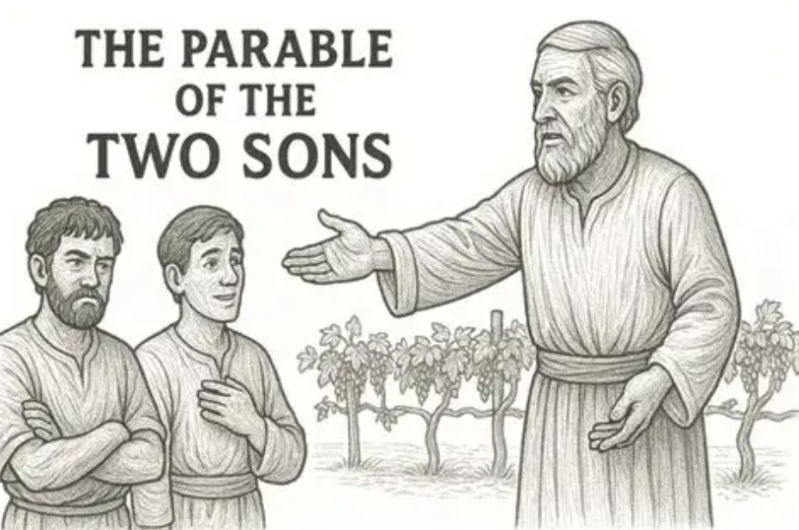
Jesus said to the chief priests and elders of the people, ‘What is your opinion? A man had two sons. He went and said to the first, “My boy, you go and work in the vineyard today.” He answered, “I will not go,” but afterwards thought better of it and went. The man then went and said the same thing to the second who answered, “Certainly, sir,” but did not go. Which of the two did the father’s will?’ ‘The first’ they said. Jesus said to them, ‘I tell you solemnly, tax collectors and prostitutes are making their way into the kingdom of God before you. For John came to you, a pattern of true righteousness, but you did not believe him, and yet the tax collectors and prostitutes did. Even after seeing that, you refused to think better of it and believe in him.’
.
.
Request to AI: Can you give a Roman Catholic explanation of the above Gospel mass reading in around 200 words?
.
.
In this Gospel, Jesus teaches that doing the will of God matters more than merely saying the right things. The two sons represent two different responses to God’s invitation. The first son initially refuses his father but later repents and goes to work in the vineyard. The second speaks respectfully and promises obedience, yet his actions contradict his words. For Catholics, the first son beautifully illustrates repentance and conversion. A person may have sinned seriously or wandered far from God, but this does not place them beyond His mercy. When someone sincerely turns back to God and changes the direction of their life, grace can restore them. This is reflected particularly in the Sacrament of Reconciliation, where repentance leads us back into communion with God. Jesus’ words about tax collectors and prostitutes would have shocked the religious leaders. He is not praising their sins; rather, He points to their willingness to recognise their need for conversion and respond to John the Baptist’s call to repentance. The second son is therefore a warning against empty religious profession. It is possible to speak about faith, know religious teachings, and outwardly appear righteous while resisting God in practice. The Gospel asks each of us: Does my daily life actually reflect the “yes” I have spoken to God? True discipleship requires faith expressed through repentance, obedience, love, and action.